
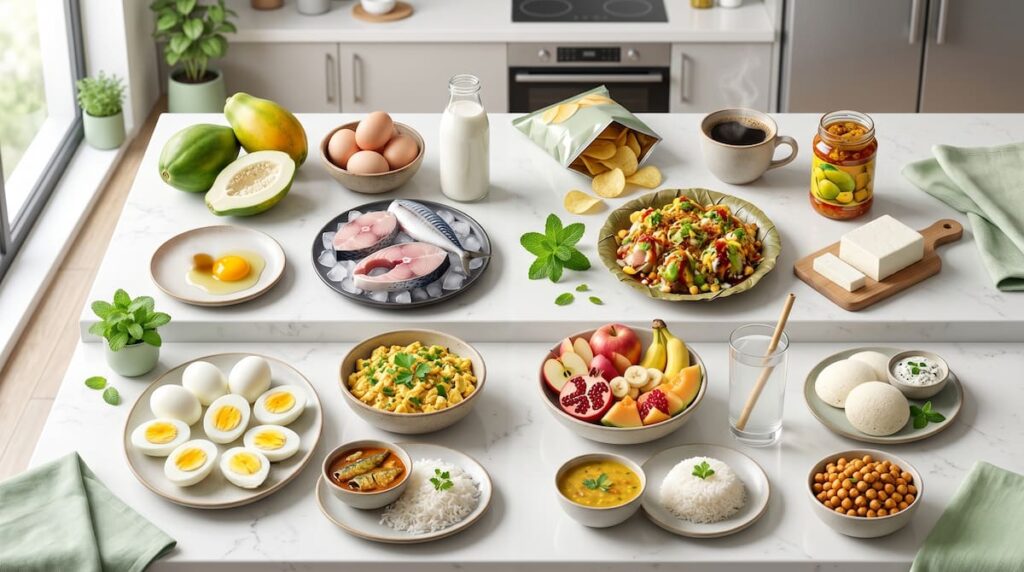
Pregnancy Foods to Avoid in India: Trimester-Wise Safety Guide

Category: Pregnancy Diet |
Guide Type: Food Safety Reference |
Applies To: All Three Trimesters |
Risk Types: Infection, Mercury, Excess Sodium, Uterine Risk |
Safe Swap Cost Impact: ₹10–₹40 difference per day |
Guideline Basis: ICMR-NIN RDA 2020 + FSSAI Food Safety Standards
Pregnancy foods to avoid in India include: raw or unripe papaya (papain triggers contractions), unpasteurised dairy and kaccha doodh (Listeria risk), raw or undercooked eggs (Salmonella risk), high-mercury fish like swordfish and shark (fetal brain damage risk), excess caffeine above 200mg/day (linked to low birth weight), raw and undercooked meat (Toxoplasma and Listeria risk), and street food and cut fruits with uncertain hygiene. These risks apply across all three trimesters and are based on ICMR-NIN and FSSAI food safety guidelines.
Introduction
Knowing which foods to avoid during pregnancy is as important as knowing which foods to eat — and in Indian diets, several everyday ingredients carry risks that are easy to overlook without specific guidance.
Indian kitchens are full of nutritious, pregnancy-friendly foods. But they also commonly include ingredients like green papaya in sabzi, street-side cut fruits, kaccha doodh, and lightly cooked eggs that become genuine safety risks during pregnancy. The reason is straightforward: pregnancy changes how your immune system functions, making the body significantly more vulnerable to bacterial infections, foodborne toxins, and the effects of certain bioactive compounds found in specific foods.
This guide focuses exclusively on pregnancy food safety — what to avoid, what to limit, why each risk matters clinically, and what safe Indian alternatives exist for every item. It does not repeat the complete nutrition structure covered in the 7-day Indian pregnancy diet plan. Instead, it gives you a practical, trimester-specific risk reference for Indian households, working mothers, and caregivers.
For broader pregnancy nutrition context, explore our pregnancy diet category and our Indian nutrition guides.
✔ Pregnant women in any trimester wanting to identify and eliminate hidden food risks
✔ Family members and caregivers planning daily meals for pregnant women at home
✔ First-time mothers unsure which Indian foods are safe versus unsafe during pregnancy
✔ Women with high-risk pregnancies (gestational diabetes, anaemia, hypertension) who need stricter dietary guardrails
✔ Post-delivery mothers transitioning to safe lactation nutrition — pair this with our kids nutrition guides for infant feeding next steps
Why Food Safety Changes Completely During Pregnancy
1. Immune Suppression Is Normal — And Necessary
During pregnancy, the immune system deliberately downregulates to prevent the body from attacking the fetus. This is a biological necessity — but it also means bacteria and pathogens that would cause mild illness in a non-pregnant person can cause serious complications during pregnancy. Listeria, for example, causes flu-like symptoms in most adults but can lead to miscarriage, stillbirth, or severe neonatal infection in pregnant women.
2. The Placental Barrier Transfers Harmful Substances to the Fetus
Many substances the mother consumes cross directly into fetal circulation. Mercury from high-mercury fish accumulates in the developing fetal nervous system. Caffeine crosses the placental barrier and affects fetal heart rate and metabolism. Listeria and Salmonella bacteria can infect amniotic fluid. This transfer pathway is what makes certain foods far more dangerous in pregnancy than at any other life stage.
3. Indian Food Habits Have Specific Risk Patterns
Several common Indian food practices carry elevated pregnancy risk: consuming kaccha (raw/unboiled) milk, using green papaya in sabzi and chutney, eating lightly cooked (runny) eggs in certain preparations, drinking chaach or lassi made from unpasteurised milk, and relying on street-side cut fruit as a daily snack. These specific risks are not always covered in general pregnancy nutrition advice, which is why this India-specific guide is necessary.
4. Some Nutrients Become Harmful at High Doses
Vitamin A from animal sources (liver, cod liver oil) becomes teratogenic — capable of causing fetal developmental abnormalities — when consumed in very high amounts during pregnancy. Sodium, normally a micronutrient, significantly worsens oedema and hypertension risk when over-consumed through pickles, papadums, and packaged snacks. The pregnancy period requires not just avoiding infection risks but also managing upper nutrient limits carefully.
Trimester-Wise Foods to Avoid: Quick Reference Table
Based on ICMR-NIN RDA 2020 and FSSAI Food Safety and Standards guidelines. Consult your doctor for personalised restrictions.
| Trimester | Foods to Avoid | Primary Risk | Safe Indian Alternative |
|---|---|---|---|
| 1st Trimester Weeks 1–12 | Raw/unripe papaya, raw eggs, unpasteurised milk, street juices, raw sprouts, excess vitamin A supplements | Uterine contractions, Salmonella, Listeria, neural tube risk from excess retinol | Ripe mango or banana, fully boiled eggs, pasteurised milk, home-made nimbu pani, steamed moong sprouts |
| 2nd Trimester Weeks 13–26 | High-mercury fish (swordfish, shark), raw meat, unpasteurised soft cheese, deep-fried foods in excess, high-sodium pickles | Fetal nervous system mercury damage, Toxoplasma, Listeria, excessive weight gain, BP elevation | Rohu or surmai fish (fully cooked), fully cooked chicken or dal, hard paneer (pasteurised), roasted snacks, small portion of homemade achaar |
| 3rd Trimester Weeks 27–40 | Excess caffeine (above 200mg/day), packaged junk food, high-sodium snacks, large meals, carbonated drinks, excess sugar | Low birth weight, oedema, gestational hypertension, digestive discomfort from large portions, blood sugar spikes | 1–2 cups of masala chai or green tea, home-cooked meals, fresh fruits, 5–6 small meals instead of 3 large ones, coconut water or plain nimbu pani |
Complete Avoidance List: Foods to Eliminate Entirely During Pregnancy
The following foods carry risks severe enough to warrant complete elimination from the pregnancy diet — not just reduction. Each is explained with the specific mechanism of harm and a practical Indian alternative.
1. Raw and Unripe Papaya (Kaccha Papita)
Risk Level: High — avoid completely
Unripe papaya contains a high concentration of papain, a proteolytic enzyme, and latex compounds. Papain has been shown in studies to mimic prostaglandins and oxytocin — the hormones that stimulate uterine contractions. Consuming raw papaya regularly during pregnancy, particularly in the first and third trimester, carries a risk of premature labour or miscarriage.
Where it hides in Indian cooking: Raw papaya sabzi, kacche papite ki sabzi, green papaya chutney, certain street-side fruit chaat mixes, and some North Indian pickle blends.
Safe Alternative: Ripe orange papaya in small amounts (under 100g) is generally considered safe. Replace raw papaya sabzi with lauki (bottle gourd) or tinda sabzi — similar texture, zero risk.
2. Unpasteurised Dairy — Kaccha Doodh, Open-Market Soft Cheese
Risk Level: High — avoid completely
Unpasteurised milk can carry Listeria monocytogenes — a bacteria that produces only mild symptoms in healthy adults but causes miscarriage, stillbirth, premature birth, or severe neonatal meningitis in pregnant women. India has a significant tradition of consuming freshly sourced milk directly from vendors without pasteurisation, which carries this specific risk. Open-market soft cheese (paneer made from unpasteurised milk at some local vendors), unboiled chaach, and lassi from uncertified sources carry the same Listeria exposure.
Where it hides in Indian kitchens: Vendor-sourced raw milk, homemade chaach from raw milk, local halwai paneer of unknown source, and certain traditional fermented dairy products.
Safe Alternative: Always use packaged, branded, pasteurised milk (Amul, Mother Dairy, local FSSAI-certified brands). Hard paneer from pasteurised milk is safe. Curd made at home from pasteurised milk is safe. Calcium from dairy remains critical during pregnancy — do not eliminate dairy, just source it safely.
3. Raw or Undercooked Eggs
Risk Level: High — avoid completely
Undercooked eggs carry a risk of Salmonella infection. Salmonella in pregnancy can cause severe dehydration, fever, and, in serious cases, septicaemia or premature labour. The risk is specifically from eggs where the white or yolk is not fully set. Eggs are nutritionally excellent during pregnancy — the problem is exclusively in how they are cooked, not in the egg itself.
Where it hides in Indian cooking: Half-fried eggs (sunny side up), bhurji where the egg is only lightly cooked, runny omelettes, and raw egg added to protein shakes or milk. Some traditional Indian dessert recipes also use raw egg — avoid these entirely during pregnancy.
Safe Alternative: Fully boiled eggs (both white and yolk firm), well-cooked omelette, egg bhurji cooked through on medium heat for at least 5 minutes. Eggs remain an excellent pregnancy food for protein and Vitamin D — just ensure complete cooking every time.
4. High-Mercury Fish — Swordfish, Shark, King Mackerel, Tilefish
Risk Level: High — avoid completely
Certain large predatory fish accumulate methylmercury from the marine food chain — a process called bioaccumulation. Methylmercury crosses the placental barrier and accumulates in the developing fetal nervous system, where it interferes with neurological development, vision, and hearing. The effects are irreversible and dose-dependent — there is no safe threshold for these specific fish during pregnancy. This applies regardless of how the fish is cooked, since mercury is not destroyed by heat.
Context for Indian markets: Swordfish and tilefish are rarely consumed in most Indian households. The more relevant concern in India is shark (commonly sold as “mangra” or “sora” in some coastal markets) and certain large tuna varieties. Always ask your fishmonger for the fish type when buying from local markets.
Safe Fish During Pregnancy in India: Rohu, catla, hilsa, pomfret, surmai (2–3 servings/week maximum), and river fish generally. These provide critical DHA for fetal brain development with low mercury exposure. Always ensure fish is fully cooked — raw or undercooked fish of any variety should be avoided.
5. Raw and Undercooked Meat
Risk Level: High — avoid completely
Undercooked meat carries Toxoplasma gondii, Listeria, and E. coli risks, all of which are significantly more dangerous during pregnancy than at other times. Toxoplasma infection during pregnancy can cause severe fetal brain damage, vision problems, or miscarriage. In Indian cooking contexts this applies to: pink or rare-cooked chicken and mutton dishes, shawarma with meat that is not thoroughly heated, and deli-style cold meats that have not been freshly cooked.
Safe Standard: All meat — chicken, mutton, fish — must be cooked until the internal temperature reaches above 74°C (well-done), with no pink visible in the centre. Reheated meat must be piping hot throughout before consuming.
Safe Alternative: Fully cooked home-made chicken curry, mutton curry, or egg curry using fresh ingredients. Indian-style slow-cooked preparations (pressure cooker curries, dum cooking) naturally ensure thorough cooking. Avoid restaurant-cooked tikka or tandoori preparations where cooking degree cannot be verified.
Foods to Limit — Not Fully Eliminate — During Pregnancy
The following items are not inherently unsafe in small amounts but carry real risks when over-consumed. These require portion discipline throughout pregnancy, with stricter limits in the third trimester.
| Food / Drink | Safe Limit | Risk of Excess | Trimester Caution |
|---|---|---|---|
| Tea and Coffee (Caffeine) | Under 200mg/day (~1–2 cups chai) | Low birth weight, restricted fetal growth, miscarriage at high doses | All trimesters — strictest in T1 |
| Pickles and Papadums | 1 small serving occasionally | Sodium overload, BP elevation, water retention (oedema) | Most critical in T3 |
| Jaggery and Mithai (Sweets) | 10–15g jaggery/day; mithai max 1 small piece | Blood sugar spikes, gestational diabetes risk, excess weight gain | All trimesters — strictest in T2 and T3 |
| Deep-Fried Snacks (Pakora, Samosa, Bhujia) | Occasional only; not daily | Trans fats from reused oil, heartburn, excess calories without nutritional benefit | All trimesters — worst in T3 (heartburn) |
| Animal Liver (Kaleji) | Avoid or max once/month in small amount | Extremely high Vitamin A (retinol) — teratogenic at excess doses | Most critical in T1 (organogenesis) |
| Packaged Chips, Biscuits, Instant Noodles | Strictly occasional — not a regular snack | High sodium, trans fats, artificial preservatives, zero nutritional value for pregnancy | All trimesters |
| Herbal Teas and Kadhas (Non-Prescribed) | Only if prescribed by doctor | Certain herbs (fenugreek in excess, aloe vera, ashwagandha) may stimulate contractions or interfere with fetal development | All trimesters |
Caffeine During Indian Pregnancy: The Chai Problem
⚠️ Important Context for Indian Households: Chai (Indian tea) is deeply embedded in daily routine, but most pregnant Indian women are not aware of how much caffeine they are actually consuming across a full day — particularly when chai is consumed 3–4 times daily as is common in many households.
| Drink | Typical Serving | Approx. Caffeine | Pregnancy Safety |
|---|---|---|---|
| Indian Masala Chai | 200ml cup | 25–50mg | 1–2 cups/day — safe |
| Filter Coffee (South Indian) | 150ml cup | 80–100mg | 1 cup/day — borderline |
| Instant Coffee | 200ml cup | 60–80mg | 1 cup/day — borderline |
| Green Tea | 200ml cup | 20–35mg | 2 cups/day — safe |
| Energy Drinks | 250ml can | 80–160mg | Avoid entirely |
| Dark Chocolate | 30g serving | 12–20mg | 1 small serving/day — safe |
💡 Key point: 3 cups of strong chai + 1 instant coffee already takes you close to the 200mg daily limit. Count all sources across the day, not just coffee.
Food Hygiene Rules That Are Non-Negotiable During Pregnancy
Beyond specific ingredients, how food is prepared and stored becomes significantly more important during pregnancy. These hygiene practices eliminate a large proportion of infection risk regardless of the food type.
| Hygiene Rule | Why It Matters in Pregnancy |
|---|---|
| Always boil or use packaged pasteurised milk | Raw milk is the primary Listeria risk in Indian households — boiling for 1–2 minutes eliminates this entirely |
| Wash all fruits and vegetables under running water before cutting | Surface contamination with E. coli and Toxoplasma from soil is eliminated by washing — cutting without washing transfers bacteria directly to the edible surface |
| Never consume cut fruits or salads from street stalls | Pre-cut fruit at room temperature for multiple hours is a high-risk contamination environment — invisible bacteria multiply rapidly in the cut surface |
| Refrigerate cooked food within 2 hours and consume within 24 hours | Room-temperature cooked food after 2 hours begins bacterial multiplication — Listeria can multiply even at refrigerator temperatures, so 24 hours is the safe outer limit for pre-cooked meals |
| Use separate cutting boards for raw meat and vegetables | Cross-contamination from raw meat to salad vegetables is a major home kitchen infection source — a single board causes Salmonella transfer even after rinsing |
| Reheat leftovers to above 70°C (piping hot throughout) | Warming food to lukewarm is not sufficient — Listeria requires high heat to be eliminated from previously cooked food |
| Avoid restaurant food with unknown sourcing — prefer home-cooked | Restaurant kitchens cannot guarantee dairy pasteurisation, egg cooking degree, or meat internal temperature — home cooking eliminates all these unknown variables |
Safe Indian Pregnancy Snacks to Replace High-Risk Foods
Every high-risk pregnancy snack habit has a safe Indian alternative that provides equivalent or better nutrition. These swaps cost ₹10–₹40 more per day at most.
| High-Risk Snack Habit | Safe Indian Swap | Key Pregnancy Nutrient Gained |
|---|---|---|
| Street-side cut fruit chaat | Home-cut ripe seasonal fruits — guava, banana, mango, orange | Vitamin C (iron absorption), Folate |
| Packaged chips or bhujia | Roasted chana (30g) or peanut chikki (1 piece) | Protein, Iron, Zinc |
| Raw sprouts from roadside vendor | Steamed moong sprouts with lemon (home-prepared) | Folate, Protein, Iron |
| 3–4 cups of strong chai daily | 2 cups of light masala chai + 1 glass warm milk + coconut water | Calcium (from milk), Electrolytes |
| Mithai or gulab jamun (2–3 pieces) | Ragi ladoo (1 piece) or til-jaggery chikki (1 piece) | Calcium (ragi), Iron (jaggery + til) |
| Deep-fried samosa or pakora | Steamed idli (2) or dhokla (2 pieces) | Protein, B-vitamins (fermented foods) |
| Raw kaccha doodh or vendor lassi | Boiled home curd or packaged brand lassi (pasteurised) | Calcium, Protein, Probiotics |
| Instant noodles or packaged soup | Homemade moong dal soup or vegetable khichdi | Protein, Folate, Iron, Fibre |
Additional Restrictions for High-Risk Pregnancies
⚠️ If you have any of the following conditions, the standard avoidance list above is a minimum — not a complete guide. Always work with your doctor or registered dietitian for condition-specific dietary restrictions.
Gestational Diabetes
Additional restrictions include all refined carbohydrates (white rice in large portions, maida-based bread, biscuits), all fruit juices (even fresh — high glycaemic load), sweet fruits like chikoo and very ripe banana in excess, and all added sugars including jaggery above 5–10g/day. For a structured diabetes-safe meal framework, explore our 7-day diabetes breakfast plan and low GI flatbread options.
Pregnancy-Induced Hypertension (PIH) or Pre-Eclampsia
Sodium restriction becomes critical — the standard limit of limiting pickles and papadums becomes an active daily sodium count target (typically under 1,500–2,000mg sodium/day as advised by your doctor). All packaged foods, instant foods, processed meats, and canned vegetables are effectively eliminated. Caffeine restriction becomes stricter.
Pregnancy Anaemia (Iron Deficiency)
Tea consumption restriction becomes critical — tannins in tea block iron absorption by up to 60%. For anaemia during pregnancy, tea must not be consumed within 1–2 hours of any iron-rich meal. Calcium supplements should not be taken simultaneously with iron-rich meals as they compete for absorption. The entire immunity and iron-supporting foods guide provides practical Indian food-first approaches to improving iron status.
⚠️ FSSAI Allergen Note: Pregnancy itself does not change food allergies — but new food sensitivities can develop during pregnancy. If you notice unusual reactions to foods you previously tolerated (hives, swelling, digestive distress), report this to your doctor immediately. Common FSSAI-listed allergens include milk/dairy, eggs, fish, tree nuts, peanuts, wheat (gluten), soy, and sesame. Pregnant women with known food allergies must work with a registered dietitian to ensure pregnancy nutrient requirements are met through safe alternatives.
As per FSSAI Food Safety and Standards (Labelling and Display) Regulations 2020.
🔗 Related GrowRain Guides for Pregnancy & Nutrition
- 7-Day Indian Pregnancy Diet Plan — complete trimester-wise meal schedule with ICMR-NIN calorie targets
- Pregnancy Diet Category — all GrowRain pregnancy nutrition guides in one place
- Immunity Boosting Foods India — iron and immunity support foods relevant to pregnancy nutrition
- Immunity & Wellness Foods Category — broader wellness nutrition for all life stages
- High Protein Indian Meal: Paneer, Dal & Quinoa — a safe, high-protein pregnancy meal option
- High Protein Indian Breakfast Recipes — safe, protein-rich morning meals for all trimesters
- 7-Day Diabetes Breakfast Plan — relevant for gestational diabetes management
- Low GI Roti for Diabetes — safe grain options for gestational diabetes
- Kids Nutrition Category — infant and child feeding guidance for post-delivery
- Indian Nutrition Guides — complete ICMR-NIN backed nutrition reference library
- All Healthy Indian Recipes — browse all GrowRain recipe categories
Frequently Asked Questions
🌿 Build your complete pregnancy nutrition foundation.
Start with the 7-day Indian pregnancy diet plan and use this guide alongside it to eliminate every hidden food risk from your daily meals.
Conclusion
Food safety during pregnancy in India is not about eliminating Indian cooking — it is about understanding which specific preparations, sources, and ingredients carry risks that do not exist at other life stages. The most dangerous foods for Indian pregnant women are often everyday household items: kaccha doodh, vendor cut fruits, green papaya sabzi, and the 4th cup of chai. These are easy to fix with simple, affordable swaps that maintain authentic Indian eating patterns.
The core principle is consistent across all three trimesters: home-cooked, fully cooked, pasteurised, and freshly prepared. This single operating rule eliminates the majority of pregnancy food risks without requiring expensive substitutions or dramatic diet changes.
Pair this guide with the 7-day Indian pregnancy diet plan for complete trimester-wise nutrition coverage. For immune support during pregnancy, explore our immunity boosting foods guide. After delivery, our kids nutrition guides cover infant and child feeding with the same ICMR-NIN data quality.
For more practical, ICMR-NIN backed nutrition guidance, explore the complete Indian nutrition guides collection on GrowRain.
Commercial Consulting · GrowRain
Pregnancy-Safe Menu Engineering & FSSAI-Compliant Nutrition Labeling for Food Businesses
Are you a restaurant owner, cloud kitchen operator, hospital dietary manager, or maternity tiffin service that serves pregnant women or is developing a maternal nutrition product line? GrowRain’s commercial consulting team helps food businesses build safe, compliant, and commercially viable pregnancy nutrition offerings:
- Identify and eliminate high-risk ingredients from existing menus — raw egg preparations, unpasteurised dairy, high-mercury fish — and replace with safe, nutritionally equivalent alternatives
- Design ICMR-NIN aligned, trimester-specific meal menus for hospital maternity wards, cloud kitchen pregnancy subscription boxes, and institutional catering
- Generate FSSAI-compliant nutrition labels with full allergen declarations for packaged pregnancy meals, tiffin services, and hospital patient food products
- Conduct food safety audits of kitchen preparation processes — hygiene protocols, temperature control, cross-contamination prevention — for kitchens serving pregnant women
- Provide menu cost optimisation: maintaining clinical nutritional standards while controlling ingredient cost per serving for hospital and cloud kitchen operators
All consulting outputs comply with FSSAI Food Safety and Standards Regulations 2020 and are backed by ICMR-NIN RDA 2020 and IFCT 2017 data.
Medical & Nutrition Disclaimer: This guide provides general food safety information for pregnancy based on ICMR-NIN Recommended Dietary Allowances (2020), FSSAI Food Safety and Standards guidelines, and standard obstetric nutrition recommendations. Information is for general educational purposes only and does not constitute medical advice. Individual dietary needs during pregnancy vary significantly based on health status, trimester, pre-existing conditions, and other factors. All dietary decisions during pregnancy — including foods to restrict or eliminate — must be made in consultation with your doctor, gynaecologist, or registered dietitian. Do not use this guide as a substitute for personalised medical or dietary guidance.
🌿 GrowRain.com — Practical Nutrition & Recipe Platform | ICMR-NIN Sourced Data | Serving All of India