
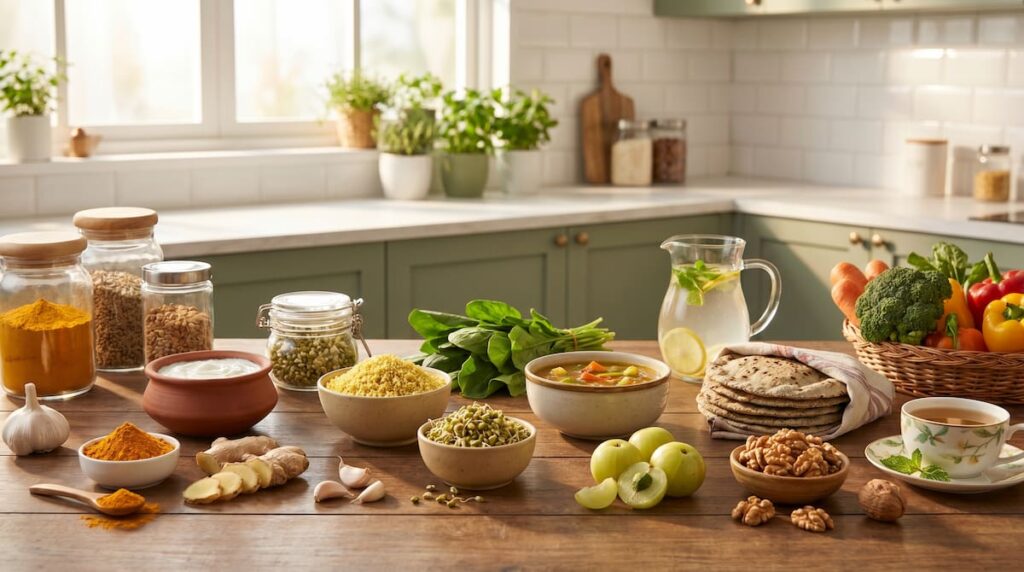
7-Day Anti-Inflammatory Indian Diet Plan for Gut Health and Weight Loss
Published: April 23, 2026 | Last Updated: April 25, 2026 | Content based on ICMR-NIN IFCT 2017 & FSSAI guidelines
Category: Nutrition Guides |
Also: Weight Loss Recipes |
Duration: 7-Day Rotational Plan |
Calories: 1,600–1,900 kcal/day |
Protein: 60–80g/day |
Daily Cost: ₹180–₹320/day (approx, current market rates) |
Key Nutrients: Fibre, Protein, Vitamin C, Antioxidants, Probiotics |
Content developed using public ICMR-NIN IFCT 2017 reference data and standard FSSAI labelling guidelines
✔ Adults dealing with bloating, poor digestion, or low energy from processed food habits
✔ People reducing refined flour, packaged snacks, and sugary drinks from daily meals
✔ Office workers with irregular meal timing and lifestyle-driven gut issues
✔ Women looking for hormone-friendly, gut-supportive food patterns
✔ Families wanting practical Indian gut health meals without expensive supplements
An anti-inflammatory Indian diet plan is a structured daily eating pattern using whole foods — turmeric, curd, millets, moong, leafy greens, nuts, seeds, and vegetable soups — while reducing fried foods, refined sugar, and processed snacks to support gut health, reduce bloating, and aid sustainable weight loss at ₹180–₹320/day.
Introduction
Many people deal with daily bloating, slow digestion, low energy, skin issues, and weight that does not respond to calorie restriction — without realising that everyday food choices may be the core driver of these symptoms.
Repeated intake of fried snacks, sweetened chai multiple times a day, refined flour products, packaged biscuits, and irregular meal timing creates a pattern of chronic low-grade inflammation. This is not the dramatic inflammation of an injury — it is a persistent, low-level state that disrupts digestion, impairs nutrient absorption, triggers fat storage, and reduces recovery. Indian diets that relied historically on curd, turmeric, ginger, seasonal vegetables, and whole grains were naturally anti-inflammatory. The shift to refined and processed food patterns has eroded these benefits.
This 7-day anti-inflammatory Indian diet plan restores that balance using practical ingredients available in every Indian kitchen at ₹180–₹320/day. It is different from the 7-day weight loss diet plan and the weight loss diet guides in its specific focus on gut microbiome support, reducing inflammatory food patterns, and improving digestion quality — not just calorie management. All nutrition values are sourced from ICMR-NIN IFCT 2017.
This guide is for general nutrition information only. It does not constitute medical advice. Consult your doctor or registered dietitian before making significant dietary changes, especially if you have a diagnosed inflammatory condition, IBS, or autoimmune disorder.
Explore more: All Indian Recipes | Nutrition Guides | Millet Diet Plan | Immunity Boosting Foods
Why Food-Driven Inflammation Matters for Indian Adults
1. Gut Health Drives More Than Digestion
The gut-associated lymphoid tissue (GALT) is one of the largest immune organs in the body — approximately 70–80% of the body’s immune cells are located in the gut lining. When the gut microbiome is disrupted by excess refined carbohydrates, seed oils, and processed food additives, it triggers a cascade of systemic inflammation that manifests as bloating, fatigue, skin irritation, joint discomfort, and stubborn weight. Probiotic-rich foods like plain curd, and prebiotic foods like moong dal and leafy greens, directly support GALT function and microbiome diversity.
2. Indian Spices Are Among the Most Studied Anti-Inflammatory Foods Globally
Turmeric contains curcumin (~30–60mg per ½ tsp as used in cooking), which supports antioxidant pathways. Ginger contains gingerols and shogaols that support anti-inflammatory processes. Garlic releases allicin on crushing, which supports immune activation. These are not exotic supplements — they are daily cooking staples in Indian kitchens that cost under ₹5 per day combined. The key is consistency: these compounds work cumulatively over weeks, not as a single serving. The black pepper + turmeric combination increases curcumin bioavailability significantly — add both to dal or warm milk daily.
3. Millets Replace Refined Carbohydrates — the Core Dietary Swap
White refined flour (maida) products — bread, biscuits, instant noodles — have a glycaemic index of 70–85, causing rapid insulin spikes that are a primary driver of post-meal inflammation. Replacing these with foxtail millet (GI ~50–54), bajra (GI ~54), and jowar (GI ~55–62) immediately reduces this inflammatory load while improving fibre intake from approximately 0.5–1g per wheat roti to 1.2–2g per millet roti. Per ICMR-NIN IFCT 2017, bajra provides 8mg iron per 100g — also directly supporting energy and oxygen transport. For a dedicated millet eating plan, see our millet diet plan for weight loss.
4. Vegetable Soups Are the Most Underused Anti-Inflammatory Meal in Indian Cooking
A well-prepared vegetable soup with garlic, ginger, turmeric, and seasonal vegetables provides 100–250 kcal, 5–12g fibre, and a combination of antioxidant compounds at approximately ₹25–₹40 per serving. Light dinners built around soup are one of the most practical strategies for reducing late-evening calorie intake and improving overnight gut recovery. Lauki (bottle gourd) soup is particularly effective — low calorie (~30 kcal per 100g), high water content, and easily digestible for a light dinner. Moong dal soup provides 7–8g protein per 100g dry weight, making it a protein-adequate light dinner option.
7-Day Anti-Inflammatory Indian Meal Plan
All values are approximate per ICMR-NIN IFCT 2017. This plan can be rotated weekly for 4–8 weeks with seasonal vegetable substitutions.
| Day | Breakfast | Lunch | Dinner | Snack | ~kcal | Cost ₹ |
|---|---|---|---|---|---|---|
| Day 1 | 2 moong dal chilla + 100g plain curd + amla (1 small) | Brown rice (½ katori) + moong dal + palak sabzi with lemon | Lauki vegetable soup + 75g paneer stir-fry with garlic | Unsweetened green tea + 8 almonds | ~1,720 | ₹210–₹240 |
| Day 2 | Foxtail millet upma with vegetables + 100g curd | Millet khichdi (bajra + moong) + cucumber raita | Lauki soup + 75g grilled paneer with turmeric | 5 walnuts + unsweetened herbal tea | ~1,680 | ₹190–₹230 |
| Day 3 | 40g rolled oats + 1 tsp chia seeds + 100g curd bowl with guava | 2 jowar roti + mixed vegetable sabzi + masoor dal | Moong dal soup + sautéed methi-spinach with garlic | 30g roasted chana + lemon water | ~1,650 | ₹180–₹220 |
| Day 4 | Vegetable poha with peanuts, lemon, and turmeric tadka | Red rice (½ katori) + rajma + beetroot sabzi + curd | Tomato-ginger soup + paneer bhurji with capsicum | 10g pumpkin seeds + amla water | ~1,780 | ₹200–₹250 |
| Day 5 | 2 ragi dosa + coconut chutney + sambar | 2 bajra roti + palak dal + cucumber salad with lemon | Mixed vegetable soup + 75g tofu or paneer stir-fry | 100g curd + 1 tsp ground flax seeds | ~1,700 | ₹210–₹260 |
| Day 6 | Moong dal chilla with paneer stuffing + curd | Foxtail millet pulao with vegetables + 100g curd raita | Bottle gourd dal curry + clear vegetable broth | Unsweetened green tea + 8 walnuts | ~1,740 | ₹220–₹300 |
| Day 7 | Foxtail millet breakfast bowl with vegetables + curd | Vegetable sambar + red rice (½ katori) + mixed salad | Clear garlic-vegetable soup + sautéed greens + dal | 1 guava + 10g pumpkin seeds + lemon water | ~1,660 | ₹200–₹280 |
| Weekly | Full 7-Day Plan — Rotate with seasonal Indian vegetable substitutions | ~11,930 | ₹1,380–₹1,780 | |||
All calorie values are approximate. Source: ICMR-NIN IFCT 2017 and USDA FoodData Central. Costs are approx current Indian market rates. Day 7 breakfast: for the full foxtail millet breakfast bowl recipe and preparation guide, see our millet diet plan for weight loss.
Key Anti-Inflammatory Indian Foods — Nutrition Data
All values per standard serving. Source: ICMR-NIN IFCT 2017 and USDA FoodData Central.
| Food | Serving | ~kcal | Key Compound | Why It Helps | Daily Cost ₹ |
|---|---|---|---|---|---|
| Turmeric (haldi) | ½ tsp (~2g) | ~8 | Curcumin ~30–60mg | Supports antioxidant and anti-inflammatory pathways; bioavailability enhanced with black pepper (piperine) | ₹1–₹2 |
| Ginger (adrak) | 10g (1 tsp grated) | ~8 | Gingerols, Shogaols | Supports gut motility and anti-inflammatory signalling; reduces bloating and nausea | ₹2–₹4 |
| Plain curd (dahi) | 100g | ~60 | Live cultures (probiotics) + Protein ~3.5g | Supports gut microbiome diversity directly linked to GALT immune response and reduced systemic inflammation | ₹8–₹12 |
| Amla (Indian gooseberry) | 50g (1 medium) | ~30 | Vitamin C ~300mg | Highest vitamin C of any common Indian food; supports antioxidant defence and iron absorption | ₹5–₹10 |
| Moong dal (split) | 100g dry | ~350 | Protein ~24g + Fibre ~7.6g | Prebiotic fibre feeds beneficial gut bacteria; complete amino acid profile when paired with rice or roti | ₹8–₹12 |
| Bajra roti (1) | ~60g | ~105 | Fibre ~1.2g + Iron ~0.8mg + GI ~54 | Lower GI than wheat roti (GI ~62–70); reduces post-meal glucose spike and inflammatory insulin response | ₹3–₹5 |
| Walnuts | 5 halves (~15g) | ~98 | ALA (omega-3) ~1.3g | Best plant-source of omega-3 fatty acids; supports anti-inflammatory eicosanoid production | ₹12–₹18 |
| Spinach (palak) | 75g cooked | ~23 | Iron ~3.1mg + Folate ~130mcg + Vitamin C ~14mg | High folate supports immune cell production; vitamin C enhances iron absorption by 2–3× when paired with lemon | ₹5–₹8 |
Foods to Include vs Foods to Limit
| ✓ Include Daily | ✗ Limit or Avoid | Why It Matters (ICMR-NIN basis) |
|---|---|---|
| Turmeric + black pepper in every meal | Soft drinks and packaged juices | Liquid fructose causes immediate glucose spikes; turmeric curcumin + piperine combination reduces inflammatory signalling consistently |
| Plain curd (100g) daily | Sweetened flavoured yoghurt | Added sugar in flavoured curd feeds pathogenic gut bacteria, negating the probiotic benefit — plain curd provides live cultures without this cost |
| Millets (bajra/jowar/foxtail) at 1 meal/day | White bread, maida products, biscuits | Refined flour GI 70–85 triggers rapid insulin spikes; millets GI 50–62 provide 2–3× more fibre per serving and reduce inflammatory glucose load |
| Moong dal or rajma at least once daily | Processed packaged snacks (namkeen, chips) | Packaged snacks are high in refined starch, added sodium, and seed oils — all drivers of gut microbiome imbalance; legumes provide prebiotic fibre and protein |
| Leafy greens (palak, methi) daily | Deep-fried snacks (samosa, vada, pakora) | Repeated deep-frying oxidises cooking oils, producing trans-fat compounds; leafy greens provide folate, vitamin C, and iron at minimal calorie cost |
| Vegetable soup at dinner | Excess tea/chai (3–4 cups with sugar) | Tannins in tea block iron absorption by up to 60%; repeated sugar in chai spikes insulin throughout the day; soup improves overnight gut recovery |
| Walnuts/almonds (10–15g) as snack | Refined sugar desserts daily | Excess refined sugar is the primary dietary driver of glycation and systemic inflammation; nuts provide omega-3 and vitamin E with low glycaemic impact |
Practical Tips to Follow This Plan Consistently
1. Start With the Turmeric + Black Pepper Habit (₹1/day)
Add ½ tsp turmeric and a pinch of black pepper to one dal or sabzi every day. This single habit costs under ₹2 and covers the most researched anti-inflammatory compound in Indian cooking. Consistency over weeks matters more than quantity.
2. Make Soup Your Default Dinner (4 nights/week)
A simple lauki, tomato-ginger, or mixed vegetable soup takes 15 minutes, costs ₹25–₹40, and reduces evening calorie intake by 150–300 kcal versus a full roti-sabzi dinner. Paired with 75g paneer or 1 bowl dal, it provides 15–20g protein at dinner — enough to prevent overnight muscle catabolism.
3. Replace One Wheat Roti with One Millet Roti Daily
You do not need to completely replace wheat immediately. Start by replacing one roti at lunch with a bajra or jowar roti. This single swap adds 0.6–1g extra fibre and reduces GI by 8–16 points per meal. Gradually increase to 2 millet rotis per day over 2–3 weeks.
4. Eat Curd with Lunch or Dinner — Not as a Dessert
Plain curd consumed during or immediately after the main meal improves gut microbiome activity and aids protein digestion. Sweetened curd eaten as a dessert negates the probiotic benefit. One 100g bowl of plain curd (₹8–₹12) covers daily probiotic needs without supplementation.
5. Walk for 10 Minutes After Each Main Meal
A 10-minute post-meal walk reduces post-prandial blood glucose spikes by 15–20% — directly reducing one of the primary drivers of low-grade inflammation. This is cost-free, requires no equipment, and compounds with dietary improvements to produce significantly better results than diet alone.
Explore More on GrowRain
🌿 Millet Diet Plan for Weight Loss — Low GI grain alternatives to rice and wheat
🌿 Healthy Indian Dinner Recipes — Light protein-forward anti-inflammatory dinner ideas
🌿 Immunity Boosting Foods India — Antioxidant and anti-inflammatory daily foods
🌿 High Protein Indian Breakfast Recipes — Morning meals with 12–25g protein
🌿 All Millet Recipes — Complete millet recipe guide archive
🌿 All GrowRain Recipes — Complete recipe and nutrition guide archive
Frequently Asked Questions
🌿 Start with one swap this week: replace one wheat roti with one bajra roti and add ½ tsp turmeric to your dal.
These two changes cost under ₹3/day and address the most common drivers of food-driven inflammation in Indian diets. Build from there.
Conclusion
An anti-inflammatory Indian diet plan does not require expensive superfoods, imported supplements, or extreme dietary restrictions. It starts with practical daily choices that most Indian kitchens already have: turmeric and black pepper in dal, plain curd with meals, one millet roti replacing one wheat roti, vegetable soup at dinner, and amla or walnuts as a snack. These simple habits help reduce the food-driven inflammation patterns most common in Indian adult diets.
The 7-day plan in this guide is designed as a starting framework. Rotate it weekly with seasonal vegetable substitutions, adjust portion sizes for your calorie needs, and combine it with consistent meal timing and post-meal walking for compounded results. For deeper nutritional support, pair this guide with our immunity boosting foods guide and the 7-day Indian weight loss diet plan for a complete daily framework.
Explore more practical Indian recipes, nutrition guides, and weight loss recipes on GrowRain.
🍽 GrowRain Commercial Nutrition Consulting
For Restaurant Owners | Cloud Kitchen Operators | Hospital & Institutional Food Managers
The anti-inflammatory food framework in this guide — curcumin-active spice use, probiotic meal integration, low-GI grain substitution, and gut-supportive meal structure — is available as a structured consulting service for food businesses and healthcare institutions. GrowRain helps operators develop gut-health menus, nutrition labels based on FSSAI reference guidelines, and therapeutic meal planning systems.
| Service | Who It Is For | Deliverable |
|---|---|---|
| Anti-Inflammatory Menu Engineering | Health Cafes, Wellness Restaurants, QSR Chains | Gut-supportive menus with turmeric-active, probiotic-rich, and low-GI meal design |
| Therapeutic Gut Health Meal Plans | Cloud Kitchens, Wellness Meal Subscription Brands | 7-day to 30-day anti-inflammatory meal plans with portion specs and ingredient sourcing guides |
| Label-ready nutrition declarations prepared using FSSAI (Labelling & Display) reference guidelines | Packaged Food Brands, Institutional Caterers | Label-ready nutrition declarations prepared using FSSAI (Labelling & Display) reference guidelines |
All consulting engagements are developed using public ICMR-NIN Recommended Dietary Allowances (2020), IFCT 2017 reference data, and standard FSSAI labelling and compliance guidelines where applicable.
Medical & Nutrition Disclaimer: This 7-day anti-inflammatory Indian diet plan provides general nutrition information based on ICMR-NIN Indian Food Composition Tables (IFCT) 2017 and USDA FoodData Central. All calorie, nutrient, and GI values are approximate reference figures. Individual nutritional needs vary significantly based on health status, body weight, medications, and medical history. This article does not diagnose, treat, cure, or prevent any disease or medical condition. It is not a substitute for personalised medical or dietary advice. Consult your doctor, gastroenterologist, or registered dietitian before making significant dietary changes, especially if you are managing inflammatory bowel disease (IBD), irritable bowel syndrome (IBS), autoimmune conditions, thyroid disorders, or any other chronic health condition.
🌿 GrowRain.com — Practical Nutrition & Recipe Platform | Using Public ICMR-NIN Reference Data | Serving All of India