
You do not need a ring light, a camera, a microphone, or a personal brand to build a YouTube channel in 2026. What you need is a system — and AI has made that system accessible to almost anyone willing to put in consistent effort.
The rise of faceless YouTube channels is one of the quieter but more significant shifts in the creator economy over the past two years. While traditional YouTube culture still rewards personality-driven content, a growing segment of the platform operates entirely without on-camera creators — and earns real, trackable income doing it.
This guide walks you through exactly how to start a faceless YouTube channel using AI: from niche selection and content production to editing, monetization, and the common mistakes that slow beginners down. If you are starting from zero, this is where that begins.
Why Faceless YouTube Channels Are Growing Fast
Between 2023 and 2026, several forces converged to make faceless YouTube not just viable but strategically attractive for a new generation of creators.
First, AI content tools crossed a quality threshold. Voiceover synthesis reached a point where AI-generated audio is difficult to distinguish from human narration in a 60-second Short. Script generation improved to the point where a well-prompted AI assistant produces a usable first draft in under two minutes. Video editing platforms like CapCut built in auto-captions, AI B-roll suggestions, and template workflows that remove the most time-consuming parts of post-production.
Second, YouTube Shorts changed the economics of channel growth. The discovery algorithm for Shorts operates differently from long-form video — new channels can reach large audiences quickly if their content hits the right signals in the first few seconds. This gives faceless channels with strong hooks a genuine path to rapid subscriber growth that did not exist before 2021.
Shorts views per day on YouTube (2025)
Average production time with AI workflow
Typical time to 1,000 subscribers (consistent posting)
Third, audience behavior shifted. Viewers engage with content based on information value and entertainment quality — not creator celebrity. Channels covering personal finance, productivity, AI tools, language learning, history, and wellness routinely accumulate hundreds of thousands of subscribers without a face ever appearing on screen.
Why 2026 Is the Right Time to Start
YouTube now reaches over 2.7 billion monthly active users. The creator economy as a whole is valued at over $127 billion and growing at 22% annually. Faceless creators are capturing an increasing share of this expansion, largely because AI tools have eliminated the production bottleneck that once made consistent posting unsustainable for a solo creator.
The result: faceless YouTube is no longer a niche experiment. It is a mainstream content format with established playbooks, proven niches, and a growing creator base that treats it like any other digital publishing business.
Can You Really Make Money Without Showing Your Face?
Yes — and the income paths are more diverse than most beginners expect.
The most commonly discussed revenue stream is YouTube AdSense through the YouTube Partner Program (YPP). Faceless channels qualify on exactly the same terms as any other channel. The YPP does not require on-camera presence.
YouTube Partner Program Requirements (2026)
| Path | Requirements | Best For |
|---|---|---|
| Long-Form Path | 1,000 subscribers + 4,000 public watch hours in 12 months | Channels combining Shorts with long-form videos |
| Shorts-First Path | 1,000 subscribers + 10 million Shorts views in 90 days | Faceless Shorts channels in high-engagement niches |
| Intermediate Tier | 500 subscribers + 3,000 watch hours or 3M Shorts views | Unlocks Super Thanks, Super Chats, channel memberships |
But AdSense alone is rarely the primary income driver for faceless channel operators in 2026. The creators who build durable income structures layer additional revenue on top:
- Affiliate marketing: Recommending relevant tools, software, or products in video descriptions and pinned comments. Finance, tech, and productivity niches convert especially well, with affiliate income often outperforming AdSense by 10x or more.
- Digital products: Ebooks, templates, guides, and online courses that align with the channel's topic. A faceless finance channel can sell a budgeting spreadsheet. A faceless AI tools channel can sell a workflow guide.
- Sponsorships: Brand deals for channels with engaged audiences above 10,000 to 20,000 subscribers, even without a visible host.
- Channel memberships and community access: Recurring revenue from viewers who want deeper content or direct access.
The honest picture: building real income from a faceless YouTube channel takes time and consistency. It is not passive on day one. It becomes progressively more passive as the content library grows and the audience compounds. Creators who treat this as a long-term publishing business — not a shortcut — are the ones building income that lasts.
Step 1: Choose a Profitable Niche
Foundation
Niche selection is the highest-leverage decision you make before producing a single video. A strong niche is specific enough to attract a defined audience, broad enough to sustain hundreds of videos, and commercially viable enough to support monetization beyond AdSense.
Best Faceless Niches in 2026
- Personal finance and money management — budgeting, saving, investing basics. One of the highest RPM categories ($10–$25 per 1,000 views).
- AI tools and productivity — tutorials, comparisons, workflow guides. High search demand, actively growing audience.
- Health and wellness information — sleep, nutrition, mental health habits. Editorial care required; strong audience loyalty.
- History and education — documentary-style storytelling. Strong watch time metrics, ideal for long-form + Shorts combination.
- Business and entrepreneurship — creator economy, freelancing, side income. Direct alignment with affiliate and digital product income.
- Tech reviews and news — covering new software, apps, and platforms. Fast content cycle; strong search intent.
Before committing to a niche, validate demand. Search the topic on YouTube and look at view counts on recent videos from channels under 100,000 subscribers. If smaller channels are getting consistent views, the algorithm is willing to serve that content to new entrants. If only large legacy channels appear, consider a more specific sub-niche where you can differentiate.
Step 2: Use AI for Script Writing
Content Production
For YouTube Shorts, the script is 30 to 90 seconds of spoken content — but the quality of those words determines whether someone watches to the end or swipes away in three seconds. The hook (the first line) is everything.
AI tools like ChatGPT and Claude are highly effective for Shorts scripting when prompted correctly. A weak prompt produces generic output. A strong prompt produces a usable first draft. The difference is specificity:
Weak prompt: “Write a YouTube Short script about saving money.”
Strong prompt: “Write a 60-second YouTube Short script for a personal finance channel. Topic: one counterintuitive habit that helps people save money without strict budgeting. Hook must create immediate curiosity. Conversational tone. End with a clear call to action to follow the channel. No filler sentences.”
Once the AI returns a draft, your job is editing — not rewriting from scratch. Tighten the hook, remove sentences that do not carry new information, and check that the ending gives the viewer a reason to engage or follow. This editing process takes five to ten minutes. That is where your judgment adds the creative layer that separates your channel from fully automated content.
Step 3: Create Voiceovers Without Recording Your Voice
Audio Production
AI voiceover technology has improved dramatically. The gap between a human voice recording and a well-configured AI voiceover has narrowed to the point where most viewers cannot reliably tell the difference in a 60-second Short.
The leading tools for AI voiceovers in 2026 include:
- ElevenLabs — industry-leading voice quality, wide range of voice styles, free tier available. Currently valued at $11 billion, indicating strong long-term platform stability.
- Murf.ai — strong studio-quality output, good for paced narration in education and finance niches.
- Play.ht — broad voice library, competitive pricing for volume creators.
- CapCut's built-in AI voice — convenient for creators who edit inside CapCut; quality has improved significantly in 2025.
When choosing a voice, match energy to niche. Finance content benefits from a calm, authoritative tone. Motivational content works better with energy and pace. Educational content needs clarity above all else. Test two or three voice options against your first script before committing — consistency builds audience familiarity over time.
Step 4: Edit Shorts Fast Using CapCut
Video Editing
CapCut has become the default editing platform for a large portion of the faceless YouTube Shorts creator economy. It is free, available on desktop and mobile, and has native features that cover almost every step of the Shorts editing workflow.
CapCut Workflow for Faceless Shorts
- Import your AI voiceover as the audio track base
- Add stock footage or screen recordings as the visual layer — Pexels and Pixabay are free royalty-free sources
- Run auto-captions — CapCut's caption generation is fast and accurate; animated captions increase watch time measurably
- Apply a text overlay for the hook — the first three seconds should visually reinforce the audio hook
- Add background music at low volume (10–20%) from CapCut's royalty-free library
- Export at 1080×1920 (9:16 vertical) for Shorts
Once you have a saved CapCut template with your brand fonts, caption style, and layout, each new Short takes 20 to 35 minutes to produce from script to finished file. That efficiency makes a consistent posting schedule sustainable over months, not just weeks.
Step 5: Monetize Beyond AdSense
Revenue Strategy
The most resilient faceless YouTube businesses in 2026 treat AdSense as one layer of income, not the entire strategy. AdSense revenue from Shorts is modest in the early stages ($0.01–$0.06 per 1,000 Shorts views), and diversification protects income when CPM rates fluctuate seasonally or algorithm changes affect view counts.
A Practical 4-Layer Monetization Stack
- Layer 1 — AdSense (YPP): Passive income that scales with views. Focus on growing the content library and watch time first. Long-form content earns significantly more per view than Shorts.
- Layer 2 — Affiliate links: Match affiliate products to the channel niche. Finance channels link to banking apps and investment platforms. AI channels link to productivity software. Tech channels link to hardware and SaaS tools.
- Layer 3 — Digital products: Create one core product — a guide, template pack, or ebook — that solves a specific problem your audience has. Even a $7 to $15 product converts reliably from an engaged audience of 5,000 to 10,000 subscribers.
- Layer 4 — External traffic assets: Use each Short to build an email list or drive traffic to a blog or product page. YouTube is the top of a funnel, not the entire business. Owned distribution insulates you from platform changes.
For creators who want a structured approach to building income layers that work alongside a YouTube channel, the Creator Income Blueprint covers platform-specific digital income systems from AI images and digital products to music licensing — income streams that can run in parallel with your channel from day one.
Common Mistakes Beginners Make
Most faceless channels that stall or fail within the first six months make one or more of the same predictable errors. Knowing them in advance is a genuine competitive advantage.
-
Switching niches too early. The algorithm needs volume and consistency before it learns who your audience is. Changing topics after 10 or 20 videos is not a pivot — it is a restart. Commit to a niche for at least 60 to 90 days before evaluating performance data.
-
Using weak hooks. The first two seconds determine whether a Short gets watched or skipped. Most beginners write informative openings instead of curiosity-driven ones. Study the hooks on Shorts with 500,000+ views in your niche before writing your own.
-
Over-optimising before posting. Spending four hours perfecting one Short instead of posting it and moving to the next is one of the most common beginner traps. Volume and iteration beat perfectionism in the Shorts format.
-
Ignoring the description and tags. Many creators put effort into the video but post it with a one-line description and no hashtags. A well-written 150-word description with relevant keywords measurably improves search discovery over time.
-
Waiting for monetization before building an email list. Your YouTube channel can be removed, penalised, or shadowbanned at any time. An email list is owned distribution. Start building one from your first 100 subscribers, not your first 10,000.
-
Using fully automated content pipelines without editorial review. YouTube's 2025 “inauthentic content” policy update explicitly targets mass-produced AI content with no creative input. AI-only workflows that post without human quality review frequently produce factual errors and tone mismatches that damage channel credibility and risk demonetization.
Best Tools for Faceless YouTube Automation
The following table covers the core tools used across the faceless YouTube Shorts workflow in 2026. Most have free tiers sufficient for beginners to validate their niche and workflow before upgrading to paid plans.
| Tool | Function | Best For | Pricing |
|---|---|---|---|
| ChatGPT / Claude | Script writing, hook generation, content ideas | All niches | Free / Paid plans |
| ElevenLabs | AI voiceover generation, natural voice quality | Narration-heavy content | Free tier + paid from $5/mo |
| CapCut | Video editing, auto-captions, templates | All Shorts creators | Free (desktop & mobile) |
| Pexels / Pixabay | Royalty-free stock footage and images | B-roll for any niche | Free |
| Canva | Thumbnails, text overlays, graphics | Visual content layers | Free / Pro |
| Murf.ai | Studio-quality AI voiceovers | Finance and education niches | Free tier + paid |
| TubeBuddy / vidIQ | Keyword research, analytics, channel SEO | Channel growth optimisation | Free tier + paid |
| Notion / Trello | Content calendar, batch planning | All creators | Free |
The most important thing about tooling is not having every tool — it is having a workflow you can execute consistently. Most productive faceless channel creators use five tools or fewer in their regular production cycle. Start lean. Upgrade strategically as your channel grows.
Final Thoughts
Starting a faceless YouTube channel using AI in 2026 is one of the most accessible entry points into the creator economy that currently exists. The barrier to production is genuinely low. The tools are affordable. The distribution — YouTube's search and Shorts algorithm — is free. The business model, when structured thoughtfully, compounds over time.
What separates the channels that grow from those that stall is not access to better AI tools. It is the discipline to post consistently, the patience to let the algorithm learn, and the strategic clarity to build income layers beyond AdSense from the beginning.
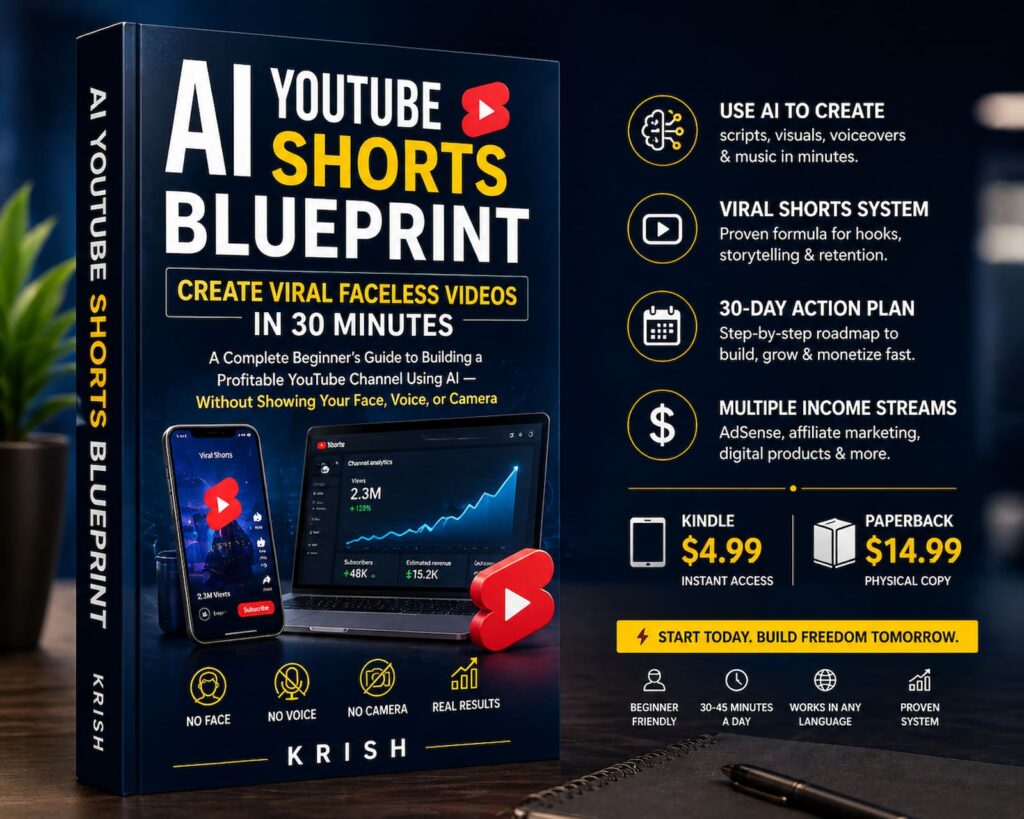
If you are serious about building this from a solid foundation — with a complete AI workflow, monetisation roadmap, and 30-day posting system already mapped out — the AI YouTube Shorts Blueprint contains the full system in structured, actionable format. Written for creators starting this journey in 2026, it covers every step from channel setup to the first income milestone.
Frequently Asked Questions
Yes, absolutely. Thousands of creators run profitable YouTube channels without ever appearing on camera. Faceless channels use screen recordings, stock footage, AI-generated visuals, animated text, and voiceover audio to produce engaging content. Niches like finance, tech reviews, motivational content, news summaries, and tutorials are especially well-suited to this format. The YouTube algorithm rewards watch time, engagement, and consistency — not whether a face appears on screen.
AI can handle a large portion of the Shorts creation process, but full automation without human oversight is not recommended for channels built for long-term growth. What AI does well: generating scripts, producing synthetic voiceovers, suggesting hooks, captioning videos, and recommending hashtags. The final edit, quality check, and posting decision still benefit from a human creative layer. The most effective creators in 2026 use AI to reduce production time from several hours down to 30 to 60 minutes per Short, while maintaining the content quality and accuracy that keeps audiences returning.
Yes, faceless YouTube monetisation is real and well-documented. Creators can qualify for the YouTube Partner Program with a faceless channel just as they would with any other channel. YouTube Shorts also has a dedicated revenue-sharing programme for eligible creators. Beyond AdSense, faceless channels commonly earn through affiliate marketing, digital product sales, sponsorships, and channel memberships. Income potential depends on niche selection, content quality, posting consistency, and audience size — not on whether the creator appears on camera.
The most widely used tools for AI-powered faceless YouTube Shorts in 2026 include: ChatGPT or Claude for script writing and hook generation; ElevenLabs, Murf, or Play.ht for AI voiceovers; CapCut for editing, auto-captions, and mobile-friendly workflow; Canva or Adobe Express for thumbnail and overlay design; and Pexels or Pixabay for royalty-free stock footage. Most creators use a combination of these tools rather than a single platform. The key is building a consistent workflow rather than chasing every new AI product that launches.
Growth timelines vary by niche, posting frequency, and content quality. Channels posting 5 to 7 Shorts per week in well-defined niches often reach 1,000 subscribers within 3 to 6 months. The average YouTube channel takes approximately 15.5 months to reach the 1,000-subscriber milestone overall, but channels combining Shorts with long-form content grow 41% faster. The most important variable is posting consistency — irregular channels grow significantly slower regardless of content quality. Channels using the Shorts-first path to YPP require 10 million Shorts views in 90 days, which is achievable in fast-growth niches like facts, finance tips, and AI tutorials.