
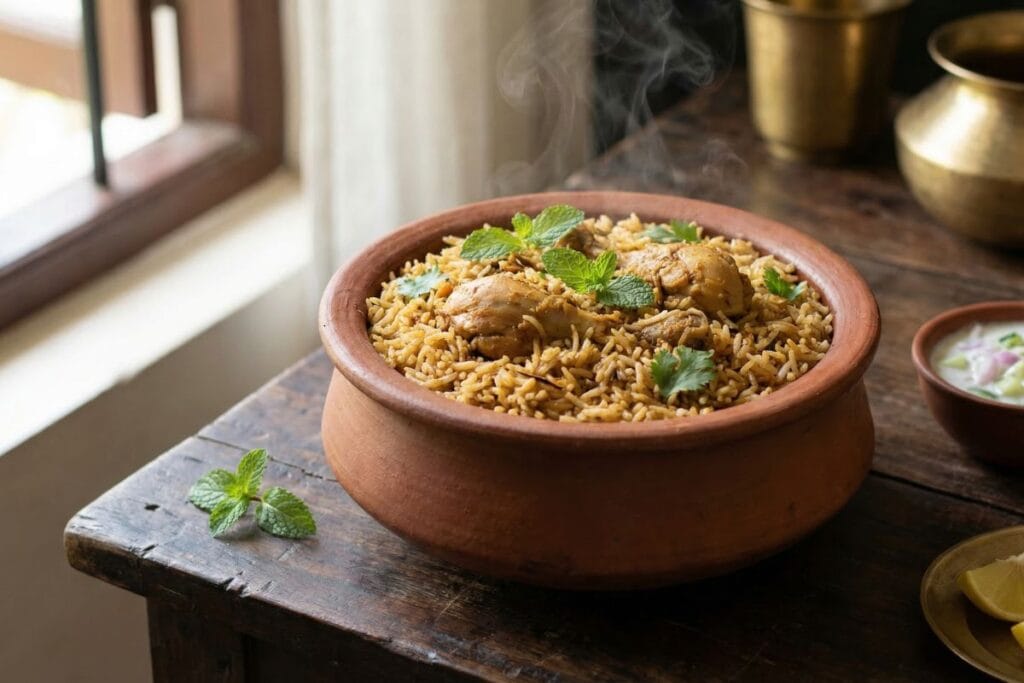
Ambur Dum Biryani Recipe — Authentic Tamil Nadu Style with Nutrition Data & Catering Guide
Category: High Protein Meals |
Cuisine: Tamil Nadu (Ambur) |
Serving: 1 plate |
Calories: 680 kcal |
Protein: 32g per serving |
Key Nutrients: Protein, Carbohydrates, Iron |
Food Cost: ₹62–₹70 per plate | Selling Price: ₹120–₹160 (approx, current market rates) |
Data Source: ICMR-NIN IFCT 2017 & USDA FoodData Central
✔ Home cooks who want to prepare authentic Ambur-style biryani with correct technique
✔ Catering professionals managing consistent quality and food cost across 50–100 covers
✔ Food business owners who need cost-controlled, high-margin recipes with full nutrition data
✔ High protein meal planners looking for complete Indian main course dishes with verified data
✔ Nutrition-conscious cooks who want allergen information, FSSAI-aligned labels, and calorie clarity
Ambur Dum Biryani is a Tamil Nadu-style biryani made with seeraga samba rice, chicken, curd, and chilli paste, slow-cooked using the dum method. It delivers approximately 680 kcal and 32g protein per serving, making it a flavourful and nutritionally complete Indian main course at ₹62–₹70 food cost per plate.
Why Ambur Biryani Is Unlike Any Other Indian Biryani
Ambur Dum Biryani stands apart from every other Indian biryani style because it achieves deep, complex flavour using fewer spices — relying instead on meat stock, chilli paste, and the natural aromas of seeraga samba rice to build taste from the inside out.
Most popular Indian biryanis — Hyderabadi, Lucknawi, Kolkata — build flavour through layers of whole spices, saffron, and heavy masala. The result is rich but often heavy on the digestive system, high in sodium, and difficult to replicate consistently in a catering environment. Ambur biryani takes the opposite approach. It was developed in the Ambur region of Tamil Nadu for a working-class audience that needed a satisfying, affordable meal — and this origin shapes everything about how it is made.
The defining characteristics are: seeraga samba rice (a short-grain variety with natural fragrance), chilli paste as the primary heat source rather than whole spices, curd as a tenderising and flavour base for the chicken, and a tight dum seal that allows steam to circulate and cook rice and meat simultaneously. The result is a biryani that is lighter in spice intensity, higher in protein per plate, and easier to batch-cook consistently.
This guide covers the complete recipe with exact ingredients, step-by-step method, full nutrition data per serving, food cost analysis, allergen information, and a catering guide for 50–100 covers. For more high-protein Indian main course options, explore our high protein meals collection. For balanced meal planning, see our Indian nutrition guides.
Explore more: High Protein Meals | Nutrition Guides | Weight Loss Recipes | Immunity & Wellness Foods
Why Ambur Biryani Stands Out — What Makes It Different
Understanding what distinguishes Ambur biryani from other styles helps you cook it correctly and maintain its character — especially important when cooking at scale for catering.
1. Seeraga samba rice — the non-negotiable ingredient
Seeraga samba is a short-grain, aromatic variety native to Tamil Nadu. Its smaller grain size and natural fragrance mean it absorbs flavour from the chicken stock more thoroughly than basmati. The result is rice where every grain carries taste, not just the surface layer. Substituting with basmati changes the character of the dish fundamentally — the fragrance profile and absorption behaviour are different enough to produce a noticeably inferior result.
2. Chilli paste replaces heavy whole spices
Where most biryanis use bay leaves, star anise, kewra, and multiple whole spices, Ambur relies primarily on chilli paste for heat and depth. This produces a clean, direct flavour rather than a layered spice profile. It also makes the dish easier to adjust for different heat tolerances — a practical advantage in catering where spice preferences vary across guests.
3. Curd as the primary marinade base
Curd tenderises chicken through lactic acid while also providing a mild flavour that balances the heat of chilli paste. The protein in curd (approximately 3.5g per 100g per ICMR-NIN IFCT 2017) contributes to the meal’s total protein count while ensuring the chicken remains moist through the dum process.
4. Dum cooking produces consistent, reproducible results
The sealed dum method controls moisture loss and ensures even heat distribution. For catering, this is critical — dum cooking in consistent vessel sizes produces predictable yield, minimising waste and portioning variance across large batches. It also makes Ambur biryani among the more scalable Indian rice dishes for food service operations.
5. Lower oil content compared to commercial biryanis
Ambur biryani uses significantly less oil than many restaurant-style biryanis. This keeps the fat content at approximately 28g per serving — high enough for satiety but lower than heavily ghee-based alternatives. For health-conscious catering or menu engineering targeting calorie-aware customers, this is a meaningful differentiator. For weight management context, see our weight loss recipes.
Nutrition Per Serving
Values are approximate per 1 plate (350–400g cooked). Source: ICMR-NIN IFCT 2017 & USDA FoodData Central.
| Nutrient | Per Serving | Primary Source |
|---|---|---|
| Calories | 680 kcal | Rice + chicken + oil |
| Protein | 32g | Chicken (bone-in) + curd |
| Carbohydrates | 75g | Seeraga samba rice |
| Fat | 28g | Chicken skin + oil |
| Fibre | 3g | Onion + whole spices |
| Sodium | 780mg | Salt + spice paste |
| Iron | ~3.5mg | Chicken + whole spices |
Note: At 32g protein per plate, this dish qualifies as a high protein Indian main course. For complete daily protein planning, see our high protein meals collection.
Allergen Information & FSSAI Label
Allergen Declaration (FSSAI guidelines)
Contains: Dairy (curd / dahi)
May contain traces of: Peanuts, Mustard
Free from: Gluten, Eggs, Fish, Soy, Tree nuts, Sesame
Always verify ingredient labels from your specific suppliers. Allergen profiles may vary based on spice brand and local sourcing.
FSSAI Nutritional Label
Non-Vegetarian ◆ | 680 kcal per serving | Contains dairy | Prepared under hygienic conditions per FSSAI Food Safety and Standards Act guidelines | Serve hot above 65°C
Food Cost Analysis — Per Plate & Per 100 Covers
Cost estimates are approximate at current Indian market rates. Actual costs will vary by city, supplier, and season.
| Ingredient | Qty (1 serving) | Market Rate | Cost (1 plate) |
|---|---|---|---|
| Seeraga samba rice | 100g | ₹100/kg | ₹10.00 |
| Chicken (bone-in) | 150g | ₹240/kg | ₹36.00 |
| Onion | 80g | ₹30/kg | ₹2.40 |
| Tomato | 50g | ₹25/kg | ₹1.25 |
| Curd (dahi) | 40g | ₹60/kg | ₹2.40 |
| Oil + spices (combined) | — | — | ₹10.00 |
| Total food cost per plate | ₹62–₹70 | ||
| Scale | Food Cost (est.) | Selling Price Range | Gross Margin |
|---|---|---|---|
| 1 plate (home) | ₹62–₹70 | — | — |
| 50 covers (catering) | ₹3,100–₹3,500 | ₹6,000–₹8,000 | ~48–56% |
| 100 covers (catering) | ₹5,700–₹6,500 | ₹12,000–₹16,000 | ~50–58% |
Margin estimates are gross food cost margin only. Labour, fuel, packaging, and overhead costs are excluded. Actual margins will vary.
Why This Recipe Works — The Science of Dum Cooking
Controlled steam environment
The sealed dum vessel traps steam generated from the chicken gravy and curd. This steam circulates around the partially cooked rice, finishing it evenly without direct water contact. The result is separate, flavour-absorbed grains rather than the sticky texture that comes from boiling rice fully before layering.
Protein retention through slow heat
Low, steady heat during dum cooking preserves more chicken protein than high-temperature methods. Rapid boiling denatures proteins aggressively and causes moisture loss — reducing both yield and texture quality. The dum method produces chicken that is tender, moist, and maintains its full protein contribution to the dish.
Flavour concentration through stock absorption
As the steam from the chicken gravy rises and condenses back into the rice, it carries the dissolved flavour compounds from the stock, chilli paste, and spices. Seeraga samba rice, with its smaller grain and higher surface-area-to-volume ratio compared to basmati, absorbs these compounds more thoroughly — which is why rice in authentic Ambur biryani is uniformly flavoured rather than tasting of plain cooked rice with a flavoured topping.
Recipe — Ingredients & Method (1 Serving)
Prep: 30 minutes | Cook: 60 minutes | Difficulty: Medium | Serves: 1
Ingredients:
- 100g seeraga samba rice
- 150g chicken, bone-in pieces
- 80g onion, thinly sliced
- 50g tomato, chopped
- 40g curd (dahi)
- Chilli paste to taste (key flavour base)
- Salt to taste
- Oil + whole spices (minimal — bay leaf, small cinnamon piece)
- Fresh mint and coriander for finishing
- Water as needed for rice (1:2.5 ratio)
Method:
- Marinate chicken: Combine chicken pieces with curd, chilli paste, and salt. Marinate for minimum 30 minutes — longer marination improves tenderness and flavour penetration.
- Prepare stock base: Heat oil in a heavy-bottomed vessel. Add sliced onion and cook until deep golden. Add tomato and cook until completely soft. Add marinated chicken and cook on medium heat until 80% done, building a thick gravy.
- Parboil rice: Wash seeraga samba rice and parboil in salted water until 60–70% cooked. The grain should have a slight bite remaining. Drain completely.
- Layer for dum: Spread parboiled rice over the chicken gravy in the vessel. Add fresh mint and coriander on top. Do not mix — layering is essential for proper steam circulation.
- Seal and cook dum: Seal the vessel tightly with a lid or dough seal. Cook on high flame for 3 minutes, then reduce to the lowest flame for 20–25 minutes. The low heat allows steam to finish cooking the rice without burning the base.
- Rest before serving: Remove from heat and rest sealed for 5 minutes. Open, gently mix from the bottom, and serve immediately with onion raita.
Protein estimate: Chicken ~21g/100g cooked + Curd ~3.5g/100g. Total per plate: ~32g. Source: ICMR-NIN IFCT 2017 & USDA FoodData Central
Catering Guide — 50 to 100 Covers
Scaling Ambur biryani for catering requires systematic batch control. The dum method does not scale linearly — each vessel has a maximum effective capacity beyond which steam distribution becomes uneven.
| Catering Parameter | Recommendation |
|---|---|
| Batch size per vessel | 25 portions per vessel maximum for even dum |
| Rice to water ratio | 1:2.5 — must be maintained consistently across all batches |
| Chicken pre-cook stage | Cook gravy to 80% before dum — complete cooking during dum stage |
| Dum timing stagger | Stagger vessel start times by 15 minutes to prevent all batches finishing simultaneously |
| Service window | Serve within 2 hours of completing dum for food safety compliance |
| Hot holding temperature | Maintain above 65°C during service — use bain-marie or hot box |
| Pre-event prep window | Marinate chicken 6–12 hours before event. Parboil rice 1 hour before service. |
Storage & Shelf Life
| Storage Condition | Duration | Notes |
|---|---|---|
| Refrigeration (below 4°C) | Up to 24 hours | Store in sealed container. Quality declines after 12 hours. |
| Room temperature | 2 hours maximum | Per FSSAI food safety guidelines for cooked rice dishes |
| Reheating method | — | Sprinkle 1–2 tbsp water, cover and heat on medium flame or microwave covered |
| Reheating limit | Once only | Do not reheat more than once — increases bacterial risk and degrades texture |
Practical Tips for Best Results
| Tip | Why It Matters |
|---|---|
| Never substitute seeraga samba with basmati | Different absorption behaviour and fragrance profile — basmati cannot replicate the authentic result |
| Use less oil to reduce fat content | Reduces fat per plate from 28g to ~20g — useful for health-conscious menus |
| Add a boiled egg for higher protein variation | One whole egg adds ~6g protein, bringing total to ~38g — useful for gym diet meal planning |
| Serve with onion raita always | Raita adds cooling balance to the chilli paste heat and contributes ~2–3g additional protein. See our immunity foods for probiotic context. |
| Include fresh mint for flavour and antioxidants | Fresh mint enhances the dish’s aroma while contributing negligible calories — a no-cost nutritional addition |
| Pair with lighter meals across the day | At 680 kcal, this is a calorie-dense meal — balance with lighter breakfast and dinner from our weight loss recipes |
Common Mistakes to Avoid
| Mistake | What Goes Wrong | Correct Approach |
|---|---|---|
| Using basmati rice | Wrong fragrance, different absorption, loses authentic character | Always use seeraga samba — non-negotiable |
| Adding too many whole spices | Overwhelms the clean chilli-stock flavour profile | Keep whole spices minimal — bay leaf and small cinnamon only |
| Incorrect water ratio | Mushy or undercooked rice — batch consistency lost | Maintain exactly 1:2.5 rice to water ratio at every scale |
| Fully cooking rice before dum | Rice overcooks during dum stage — becomes soggy | Parboil to 60–70% only — dum finishes the cooking |
| High heat throughout dum | Burns the base, uneven cooking, dry rice on top | High flame 3 minutes only, then lowest flame for 20–25 minutes |
| Serving immediately after dum | Steam still active — rice tears when mixing, grains stick | Rest sealed for 5 minutes before opening and mixing |
Frequently Asked Questions
Explore more high protein Indian recipes and nutrition guides on GrowRain.
Build a complete meal plan with verified ICMR-NIN sourced nutrition data across breakfast, lunch, and dinner.
Conclusion
Ambur Dum Biryani is one of India’s most practical and reproducible biryanis for both home cooking and catering. Its dependence on a small, well-controlled set of ingredients — seeraga samba rice, chicken, curd, and chilli paste — means that quality is primarily a function of technique rather than ingredient sourcing complexity.
At 680 kcal and 32g protein per plate with a food cost of ₹62–₹70, it offers a strong nutritional profile and reasonable margin for food businesses. The dum method, when applied correctly with the batch controls outlined in this guide, produces consistent results at 50–100 covers without significant quality degradation.
For complete daily meal planning around this dish, explore our high protein meals for complementary breakfast and lunch options, and our Indian nutrition guides for balanced diet planning. For lighter meal pairings, see our weight loss recipes and immunity and wellness foods.
Nutrition & Food Safety Disclaimer: Nutrition values are approximate and sourced from ICMR-NIN Indian Food Composition Tables (IFCT) 2017 and USDA FoodData Central. Actual values may vary based on ingredient brand, sourcing, portion size, and preparation method. Cost estimates are approximate at current Indian market rates and will vary by region and supplier. Food safety guidance follows FSSAI regulations — always maintain proper temperature controls and hygiene standards. This content is for general information only and does not constitute medical or dietary advice. Consult a registered dietitian for personalised guidance.
🌿 GrowRain.com — Practical Nutrition & Recipe Platform | ICMR-NIN Sourced Data | Serving All of India